Feet & Footwear Sizing Guide
Updated:
A guide for anyone to find the best-fitting running shoes once and for all.
TIP Bookmark this page as the guide will be updated often
Intro
When I started trail running, I was very fortunate to get right into a pair of shoes that fit me quite nicely – or sort of. They were a pair of what I now consider legendary shoes: the INOV8 X-Talon 212.
What initially convinced me was that INOV8 had a good reputation among the skyrunning1 community. Another reason was that the X-Talons were offered in two options: precision and wide fits – I have wide feet. So, as any intelligent person, I obviously got myself a pair of wide… …precision X-Talons.
Yes! I did that. “Precision” sounded muuuch better, more pro, if you will. On shorter distances they were quite “precise”. Longer runs (>20K), on the other hand, meant that I’d likely lose a nail or two.
It didn’t matter, I was a happy runner and I took it as part of the deal of being a long-distance runner.
But as any self-proclaimed happy human, I did what happy humans do: looked at “my neighbour’s” greener grass. The result couldn’t have been anything other than me turning grumpy and never finding a good-fitting pair of shoes. That got me on a long quest to learn about my feet, understand my preferences, and accept imperfection.
This is the guide I wish I had read when I started running. I write about what I’ve learnt and hope it helps others find their next pair of running shoes with fewer mistakes than I made.
In this short guide, I want to devise some strategies for the uninitiated on how to find the best-fitting pair of kicks.
Start With Your Feet
This is so obvious that it pains me to write. Yet, we tend to ignore the clues our feet are constantly giving us: blisters, blue toenails, overheating, the list goes on. Each foot tells a different story. For example, my right foot has a higher instep height than my left. So when I try on shoes, I start with my right foot.
Needless to say: right and left feet aren’t equal.
The dominant side tends to be slightly bigger. Other foot shape oddities and mechanical properties are: foot arch, Morton’s2 toe – when the first metatarsal is shorter than the second –, pronation3, or any other quirks our feet may have.
Another consideration about the size of your feet: they change! When running for long distances, your feet will swell. So a shoe that you thought fit you precisely when shopping has now become a tad smaller – or to be more precise – your feet grew bigger.
Foot Anatomy & Measurements
- Foot Length: the distance from your heel to the tip of your longest toe. This is what shoe sizes are based on.
- Foot Width: the measurement across the widest part of your foot, typically measured from the outside of your little toe side to the outside of your big toe side. This determines whether you need standard, wide, or narrow width shoes.
- Ball Girth: the circumference around the widest part of the metatarsal heads.
- Instep: the measurement around the arch of your foot – the inner curve along the top. This affects how snugly a shoe sits and whether it stays on your foot properly.
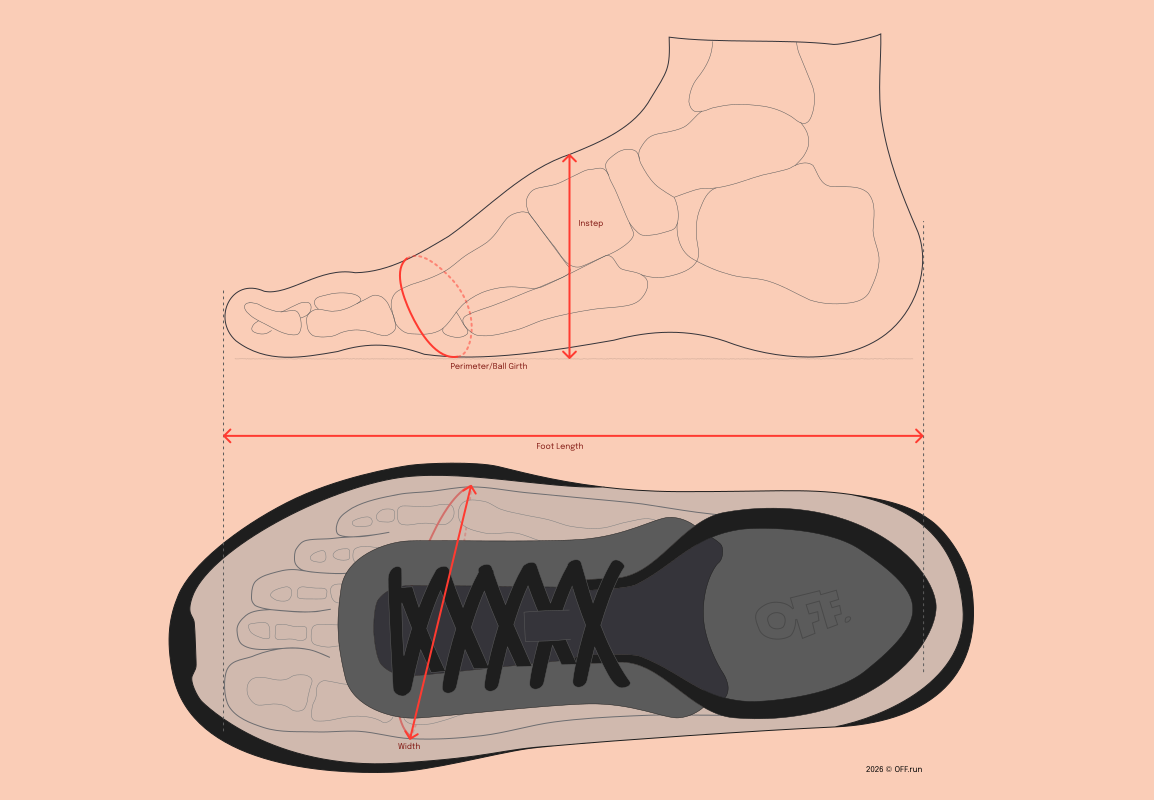
Now that you have a better idea of the anatomy of your feet, go on and measure them.
Measuring Your Feet
Measure them later in the day, as feet tend to swell over time. Note that I say feet, and not foot. That is because – as mentioned earlier –, seldom are our right and left feet of the same size. Start by measuring both feet, and use the measurements of the larger foot.
Measuring your feet, step-by-step
This is a well-tried way to measure both of your feet to help choose the right size footwear. Repeat these steps for each foot. All you’ll need is: pencil, blank sheet of paper, and a ruler. If you want to go all in and measure the instep, you’ll need a flexible tape measure. Measure them in centimeters. Everything will make more sense later in the article.*
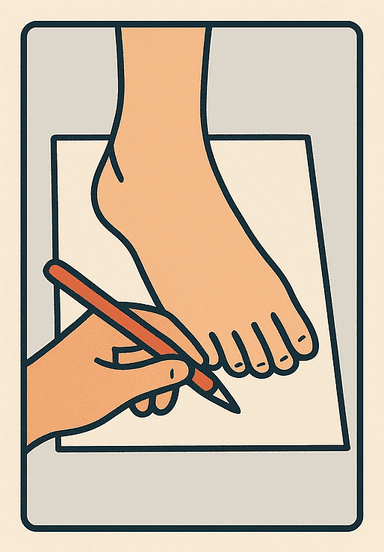
Have the paper on the floor, place your foot over it. Make sure your foot is firmly planted on the ground. Do it sitting, if that helps. With the pencil at hand and perpendicular to the ground, trace your foot, avoid moving it or the paper and make sure the pencil is following the contour of your foot, neither under nor away.
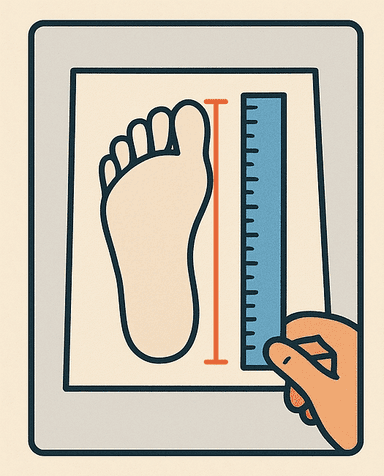
Move your foot away, you've made your own footprint! Get the ruler, or any measuring tool of your choice, and measure from the tip of your longest toe to the edge of your heel. Write it down.
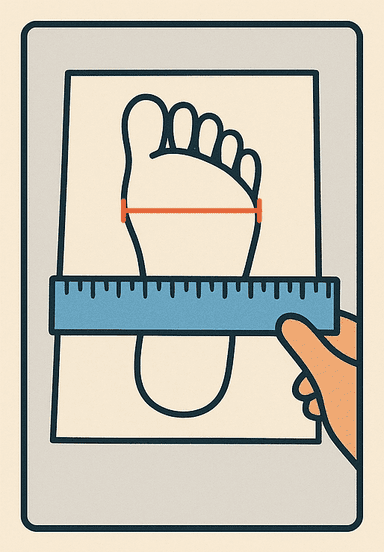
Move to measure the width of your foot by measuring it at the widest part. Write that down too.
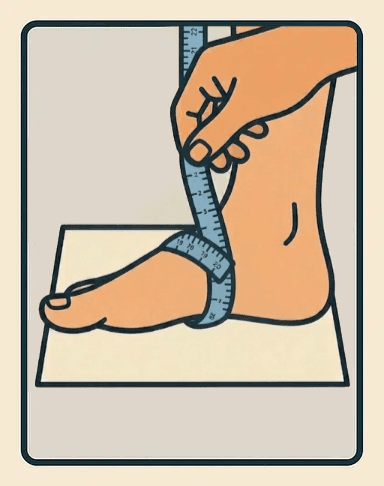
[OPTIONAL] To measure your instep, take a flexible measuring tape and wrap it over the highest part of your midfoot – just behind your toes and over the arch – circling the tape around until it meets itself. Make sure the tape is snug but not tight, and that it sits flat on your skin all the way around.
Repeat the steps with the other foot. Most likely your feet are not the same size. If that's the case, use the measurements of the larger foot.
*For those living in a world ruled by imperial metrics, this is your chance to move to the metric system, at least for once.
Great! You have done all the hard work of drawing your feet. Now let me take you to the other part of this guide: footwear.
Footwear
They come in all sizes, colours, shapes, and forms. It would be silly for me to try to cover everything. So the focus will be on running shoe anatomy and sizing.
Sizing Systems
Historically, countries adopted sizing systems based on how their societies operated. In countries such as the USA and Canada, this was largely a legacy of their colonial periods. Regardless, these are the most popular sizing systems in use.
Length
| Sizing System | Countries/Regions |
|---|---|
| United States (Customary) | United States, Canada (with different sizing depending on gender) |
| United Kingdom | United Kingdom, Ireland, South Africa, India (often) |
| Continental Europe | Most of Europe (Germany, France, Italy, Spain, Netherlands, etc.), parts of the Middle East |
| Brazilian | Brazil (differs from EU sizing, by subtracting EU sizes by 2) |
| Centimeter* | Japan, Korea, sometimes for ski boots globally |
| Mondopoint* | Japan, Korea, China, Russia, ISO international standard |
Width
In general, sizing is mainly given in the length of the foot. However, some brands like INOV8 – mentioned earlier –, give extra options to choose from regarding their shoe widths. Wide, normal, narrow, and so on. Naming varies from brand to brand. But did you know there’s a system for that too? And naturally… there’s more than one.
| N-M-R-W system | North American system | North American variant | UK system | German system |
|---|---|---|---|---|
| SS (super slim) | AAAA | 4A | ||
| S (slim) | AAA | 3A | ||
| N (narrow) | AA | 2A | B ("narrow") | E ("very slim") |
| A | A | C | E | |
| M (medium) | B | B | D ("standard") | F ("slim") |
| C | C | D | F | |
| R (regular) | D | D | D | F |
| W (wide) | E | E | E ("wide") | G ("comfort") |
| XW/EW (extra wide) WW (wide wide) | EE | 2E | EE | H ("strong") |
| UW (ultra wide) WWW | EEE | 3E | EEE | J ("super wide") |
| EEEE | 4E | K | ||
| XXW (extra extra wide) | EEEEE | 5E | L | |
| EEEEEE | 6E | M |
Brands like Altra have become popular by focusing on products with wider toe boxes or zero-drop soles.5 Being that specific in the beginning helped to set them apart from mainstream competitors.
Can We Have Three-Dimensional Sizing?
Since our feet are three-dimensional, why wouldn’t shoemakers give us measuring systems for each foot dimension? My uneducated guess is costs. Imagine a brand making a single shoe model in, say, 15 different length sizes, 3 widths, 3 instep heights, and at least a couple of different colours. And let’s not forget, each side is one item. In one model we’re talking about 15 × 3 × 3 × 2 × 2 = 540. Yes, you read it right. We’re talking 540 unique shoes for only one single model! That should be a good reason why things are the way they are.
Same Brand, Different Manufacturers
In the current state of shoe manufacturing, many brands are becoming less like manufacturers and more like creators of new technologies and designers of new styles. Instead of making shoes themselves, they often rely on supplier factories around the world to bring their vision to life. That begs the question:
If the likes of Adidas, Nike, or any other brand were to make their shoes in different factories, would the end product still be the same?
In theory… yes? They should be… the same? But reality might tell otherwise. Models produced in different facilities are likely to show some variation beyond a brand’s standards, whether the brand wants that or not.
My point is that this makes consistent sizing across different models even harder, unless there is a measurement system that stays consistent every single time.
Which Size is Right Then?
Okay, you’ve read this far and you’re now probably more confused than confident about going out to buy your next pairs. Let’s put aside all the quirks you’ve read and focus on small achievable solutions.
I Choose Mondo
After I discovered the mondo system6, I never looked back. No matter which shoe brand I’m trying, I know the length of my feet and I look no further than the mondo charts. Any other system just adds confusion. Mondo gives the consistency that only a standard such as the metric system can provide. Every time it’s spot on! When looking for the right shoe size, stick to the mondo system.
Final Tips
If you’re planning to run long distances, consider adding up 0.5–0.75 cm more to the size you measured when buying a new pair. Depending on the shoe’s shape, extra toe room can make the fit trickier at first, but it’s usually worth the effort. That’s because extra room for your toes can also mean extra room in other parts of the shoe where you may not need it. You’ll have to try a myriad of different setups with trial and error.
Do not despair.
From personal experience, any extra toe room has always been worth it. If the shoes get a bit loose on the instep, try wearing thicker socks or tighter lacing. If neither works, these probably aren’t the right shoes made for your feet.
A [Short] Note on Socks
Not to make things even more complicated, but socks are another factor in the “perfect fit” equation. They can help your feet sit better in your shoes, keep them warm, reduce or cause blisters, and influence fit in ways they rarely get credit for. Beyond any magical healing properties you might hear about, what is really important is for you to try the combinations that feel right for your case. On the plus side, once you get your shoe length correct, playing with the sock combinations is way cheaper than buying new shoes.
Socks come in many shapes and forms, materials and fits. They could’ve been a science of their own. What you want from them is to help you with:
- Temperature control: Keep your feet at a comfortable temperature. You want them to be warm enough on a cold day. Whilst on a hot day, you don’t want your feet boiling and sweating either. It’s a fine balance that can be tricky to master and mostly comes with experience.
- Friction: You want your socks to give you the right amount of friction so your feet aren’t dancing around inside your shoes. Get too much of it and they’ll heat up. Get that long enough and you’ll end up getting blisters.
- Moisture: similar to temperature and friction, you don’t want your feet getting sweaty nor wet. They should remain dry, or dry out as soon as possible. Otherwise you’ll run get blisters. Either because they’re sweaty (it increases friction), or if wet for a prolonged time, that will cause skin maceration, also known as trench foot.7
It’s About How it Feels
In the end, it doesn’t matter what I write, what others write, what you hear or see anywhere. It’s what you feel while running and what your feet tell you that should determine the right-fit shoes for you.
It’s what you feel and what your feet tell you that should determine the right shoes for you.
Ignore the marketing buzzwords and the technology claims. If you’re not a top athlete, shoes from a boutique brand or a cheap one won’t make a big difference in your results. Real gains are made with solid training, not equipment. Pay attention to what works and ditch what doesn’t. You want a net positive effect in your overall running experience.
Listen to this article
Footnotes
-
Skyrunning
Skyrunning is a sport of mountain running above 2,000 metres (6,600 ft) where the minimum average incline is 6% over the total distance and at least 5% has an incline of 30% or more. The climbing difficulty does not exceed II grade UIAA. Poles, crampons, and hands may be used to aid progress. The governing body is the International Skyrunning Federation. Wikipedia CC BY-SA 4.0 ↩ -
Morton's toe
Morton's toe, also known as Greek toe, is the condition of having a first metatarsal bone that is shorter than the second metatarsal (see diagram). It is a type of brachymetatarsia. This condition is the result of a premature closing of the first metatarsal's growth plate, resulting in a short big toe, giving the second toe the appearance of being long compared to the first toe. Wikipedia CC BY-SA 4.0 ↩ -
Pronation of the foot
Pronation is a natural movement of the foot that occurs during foot landing while running or walking. Composed of three cardinal plane components: subtalar eversion, ankle dorsiflexion, and forefoot abduction, these three distinct motions of the foot occur simultaneously during the pronation phase. Wikipedia CC BY-SA 4.0 ↩ -
“Drop” in this context is the difference between the height of the sole at the heel in relation to the height of the sole at the toes. If you were to draw a line from the heel to the toe, it would slope down by
x mm. Although not a defined standard, it’s fair to say that anything below 5–6 mm can be considered a low-drop shoe. ↩ -
Mondopoint System
Footwear sizing — Mondopoint system of sizing and marking ISO 9407:2019(en) ↩ -
Trench foot
Trench foot, also known by other names, is a type of foot damage due to moisture. Initial symptoms often include tingling or itching which can progress to numbness. The feet may become red or bluish in color. As the condition worsens the feet can start to swell and smell of decay. Complications may include skin breakdown or infection. Wikipedia CC BY-SA 4.0 ↩